Thứ Hai, 27 tháng 10, 2008

Want To Lose Weight, Use Pedometer!

When a person is overweight, chances that he or she would become victim of heart disease is much higher. In order to prevent heart disease, overweight or obese people are anxiously finding means to help them cut down the extra weight they have.

United States researchers from the University of Michigan reported in their study on January 15, 2008 in the “Annals of Family Medicine” that walking can actually help people lose weight, especially if they use a pedometer to ensure they are going far enough.

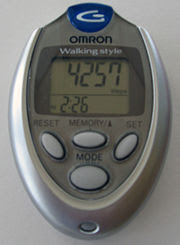
A pedometer (also known as Tomish-meter or step counter) is a device, which counts each step a person takes by detecting the motion of their hips. Originally, it was used by people engaged in sports and physical fitness but now it becomes popular as an everyday exercise measurer and motivator.

The modern pedometer is usually portable and electronic or electromechanical; a typical one is shown below:


It was observed in the study that people who walked 20 to 40 minutes a day lost a small but steady amount of weight. According to the researchers, the increase in physical activity can have health benefits independent of weight loss. In fact, increasing physical activity is expected to lower the risk of cardiovascular problems and blood pressure, and will help dieters keep lean muscle tissue when they are dieting.

A total of 9 studies involving 307 men and women were reviewed in the study. The participants took part in the studies of pedometer use, which ranged from 4 weeks to a year.

Participants in all the studies except one lost some weight (about 0.05 kilo a week on average). The weight loss was found to be 'remarkably consistent' across all of the studies, and this added up to 2.25 kilos over a year.

It is believed that changing eating habits could help even more. People could add between 2,000 steps per day to more than 4,000 steps per day. For an average person, 2,000 steps equals to about 0.6 km.

Thứ Bảy, 25 tháng 10, 2008

How Adma Is Linked To Heart Risk in Diabetics?

Adma is the abbreviation for asymmetric dimethylarginine. It is a naturally occurring component of human blood plasma, and it can inhibit a compound that is capable of dilating blood vessels.

Diabetes has been identified as a risk factor for heart disease. A recent study by Steno Diabetes Center, Gentofte, Denmark found that people with Type-1 diabetes and kidney disease are at higher risk of heart-related events and progressive kidney disease because of the high blood levels of Adma.

In fact, previous research has already shown that high blood levels of Adma do reduce the ability of the blood vessels to widen, and this would lead to an increased risk of heart and blood vessel disease.

In the new study, researchers investigated how the value of Adma could be related to heart and kidney events in 397 Type-1 diabetic patients with diabetic kidney disease and 175 diabetic controls without kidney disease.

For patients with diabetics with kidney disease, those with Adma levels above the median were more likely (43.4 percent) to suffer a fatal or nonfatal major cardiovascular event such as heart attack than those with Adma levels below the median (19.4 percent).

Moreover, patients with Adma levels above the median also experienced a faster decline in their kidney function than those with lower Adma levels. Meanwhile, the researchers also indicated that patients with higher Adma levels were 3.2 times more likely to develop end-stage renal disease (the most advanced form of kidney disease) than those with lower levels of Adma.

The overall mortality was found to be 67 percent higher for patients with higher Adma levels than those with lower Adma levels.

If other future studies could also confirm similar finding, then Adma might be used by doctors to identify relevant Type-1 diabetic who are at particularly high risk of adverse heart and kidney-related events.

Thứ Năm, 23 tháng 10, 2008

Modified CPR Could Save More Life!

Cardiopulmonary resuscitation (CPR) is a life-saving medical procedure that is useful in retrieving a victim who experiences certain life-threatening emergencies including heart attack, cardiac arrest, or respiratory arrest that cause the breathing or heartbeat to stop.

Standard CPR involves compressions of the chest, but the modified one involves pumping both the abdomen and the chest at the same time. It was found that such modified CPR could double the survival rate of victims who collapse with a heart attack

A 5-year study in Poland jointly conducted by Katowice's Silesian School of Medicine, Nowy Targ's City Hospital, and Dabrowa Gornicza's City Hospital has found that this modified form of CPR revived 38 percent of patients, compared to 16 percent saved by the standard CPR. Meanwhile, the rate of those discharged from hospital after a sudden-collapse was also improved from 10 percent to 24 percent.

These results were presented in September 2007 at the European Society of Cardiology Congress in Vienna, which had more than 25,000 attendees.

In the study, the modified method had been performed on the 207 patients with an average age of 71, who had suddenly collapsed and become unconscious from 2002 to 2006. Then results were compared with that of a group of 138 similar patients, with an average age of 69 on whom standard CPR had been used in 2000 and 2001.

Standard CPR is no doubt a resuscitative procedure to treat those experiencing sudden cardiac arrest, however, it is effective in only 5 to 10 percent of patients due to insufficient arterial pressure generated by chest compressions alone. In view of this, the researchers introduced simultaneous abdominal compressions.

According to the study, the modified method not just raised the survival rate, but also caused fewer complications than standard CPR. Hence, they recommended that it should be made an element of training courses in resuscitation.

One should also note that CPR is unlikely to restart the heart. Its purpose is to maintain a flow of oxygenated blood to the brain and the heart so that tissue death could be delayed and chances for a successful resuscitation without permanent brain damage could be extended.

Thứ Ba, 21 tháng 10, 2008

How Would Hostility Raise Heart Disease Risk?

Before we get into the topic, we need to understand 3 terms: free radical, antioxidant and oxidative stress. Let us look at how they are related.

Technically, oxidative stress is a condition, which occurs when production of free radicals in the human body exceeds the body's ability to neutralize and eliminate them. Free radicals would start chain reactions that disturb the body’s ability to neutralize them, hence resulting in tissue or cell damage. Oxidative stress has been associated with heart disease, cancer and other illnesses.

Antioxidants could stop these chain reactions by removing free radical intermediates and inhibit other oxidation reactions by being oxidized themselves. Antioxidant vitamins like vitamin C and E can help counteract oxidative stress. On the other hand, activities like smoking and pollution can actually increase it.

A study has indicated that hostility could raise a person’s risk of heart disease by depleting the level of certain heart-healthy antioxidants.

The researchers from the University of Minneapolis, who carried out the study, suggested that antioxidants could help explain why hostile individuals are more likely to smoke and drink, and poor diet and smoking can deplete antioxidants.

In their study, the researchers investigated 3,579 men and women of the age between 18 and 30 years old who were participating in the so-called Cardiovascular Risk Development in Young Adults study. Their levels of several different carotenoids and tocopherols (vitamin E) were measured.

It was found that people having high levels of hostility at the beginning of the study were more likely to have lower levels of several types of carotenoids 7 years later, but hostility did not predict levels of tocopherols or lycopene. The increased risk was found to be, nevertheless, small but significant.

Lifestyle factors such as diet, smoking and drinking probably play a part in explaining why hostility reduces levels of antioxidants, but the researchers are not clear whether the differences are importantly related to the risk of coronary heart disease. Therefore, further study is necessary.

Chủ Nhật, 19 tháng 10, 2008

Is Wealth Really Associated with Stroke Risk?

According to the American Heart Association, every year there are about 780,000 Americans suffering strokes; about 27 percent of which occur before the age of 65.

If someone tells you that “a person’s risk of getting stroke depends on how rich he or she is”, do you believe? Initially, I was doubtful about the statement because many health experts have in fact linked many health hazards like heart disease, diabetes, hypertension, obesity, stroke, etc. with the prevailing wealthy lifestyles.

Nevertheless, the statement was supported by a study conducted by Erasmus Medical Center, Rotterdam, The Netherlands and its findings were published in the American Heart Association's journal “Stroke”.

The researchers found that people who aged 50 to 64 years old and wealthy seems to protect them against stroke, but wealth appears to make little difference in stroke risk after the age of 65.

In other words, lower wealth, education and income are associated with increased stroke risk up to the age of 65, and wealth is the strongest predictor of stroke among the factors sought by the researchers.

In the study, the effect of income (annual earnings), wealth (total of all assets minus liabilities) and education on stroke risk were assessed in 19,445 Americans in the ongoing University of Michigan Health and Retirement Study (HRS) that surveys Americans of the age of 50 and above every 2 years.

All of these participants were free from stroke when they were assessed in 1992, 1993 or 1998. During an average of 8.5 years, 1,542 people in the study were found to have a stroke. According to the researchers, the stroke risk of the 10 percent of people with the lowest wealth at the age of 50 to 64 was 3 times higher than that of those with the highest wealth.

It appears that the lack of material resources, in particularly wealth, would strongly affect people’s chances of a first stroke. This also means that closing the wealth gap for people of the age of 50 to 64 could actually help reduce the large disparities in stroke.

It is believed that wealth would increase access to medical care as well as other material and psychosocial resources. However, the researchers were quite surprised to see that stroke risk was not significantly different between the 2 wealth groups for both men and women who aged 65 and above.

Thứ Sáu, 17 tháng 10, 2008

Let Your Baby Sleep Enough To Avoid Overweight!

Childhood overweight or obesity has been a hot topic among people. This is because the extra weight accumulated in the body of these youngsters may greatly increase their risk of become victims of heart disease, diabetes, hypertension (high blood pressure), stroke, and even cancer in their life later.

Many causes, for example, over-eating and physical inactivity, can actually help a person gain weight or become obese. Nevertheless, a recent study revealed that babies with insufficient sleep could become overweight too!

Published in the “Archives of Pediatrics and Adolescent Medicine”, the findings from the so-called “Project Viva” study indicated that infants who sleep an average of less than 12 hours per day have doubled their risk of being overweight by the age of 3, compared to babies who get at least 12 hours of sleep per day

The adverse effect of shorter sleep duration was especially obvious among children who also watched at least 2 hours of television per day.

Previous research has already linked short sleep duration to obesity in older children, adolescents and adults, but the current study examined the relationship between the hours of sleep during infancy and weight in childhood.

The mothers of 915 infants who were involved in the study were asked at 6 months, 1 year, and 2 years how many hours their child slept in a 24-hour period, including naps. At the age of 3, 9 percent of children were overweight, which was defined as having a body mass index (BMI) for age and sex in the 95th percentile or greater.

After removing the influence of other variables like demographics, maternal characteristics, breast-feeding duration, and birth weight, the researchers found that infants who slept an average of less than 12 hours per day were almost twice as likely to be overweight.

Moreover, a much higher association between sleep duration of less than 12 hours per day and television viewing of more than 2 hours per day was also noted. Such combination significantly raises the chances of becoming overweight by nearly 6 times.

Based on the findings, the researchers suggested that childhood overweight prevention should target not only on the reduction in television viewing but also on making sure adequate sleep duration.

Thứ Tư, 15 tháng 10, 2008

Music Listening is a Viable Option to Lower Blood Pressure!

To some people, listening to music may just be a hobby, but to people with high blood pressure (hypertension), it could be a way to help them lower their blood pressure.

A study by the University of Florence in Italy reported at the American Society of Hypertension meeting in New Orleans in May 2008 that people with mild hypertension had their blood pressure significantly reduced by listening to classical, Celtic or India (raga) music for 30 minutes a day for a month.

Listening to music could be soothing. It has already been associated with controlling patient with pain or anxiety and was reported acutely reducing blood pressure. For the very first time, however, daily music listening does show an impact on ambulatory blood pressure. Ambulatory blood pressure refers to readings taken repeatedly over the course of a day.

The researchers enrolled 48 adults who aged 45 to 70 and took medication for controlling mild hypertension into the study. These participants were divided into 2 groups. The first consisted of 28 who listened to 30 minutes of 'rhythmically homogeneous' classical, Celtic or raga music on a daily basis while practicing slow and controlled breathing exercises. The remaining 20 participants were put in the control group and no changes were made on their daily routine.

Blood pressure readings obtained one and four weeks later showed that systolic blood pressure (the top number in the blood pressure reading) dropped significantly for the music listeners. In contrast, people in the control group experienced only small, non-significant reductions in blood pressure.

The statistics in the current study indicated that something as simple, easy and enjoyable as daily music listening combining with slow abdominal breathing might help people naturally lower their blood pressure.

The health experts have predicted that some 56 billion people worldwide will be hypertensive by 2025, despite the global focus on prevention. People with high blood pressure are known to have a higher risk of getting heart disease, stroke, kidney failure, etc.

As such, the new findings would instill confidence to health professionals who could explore music listening as a safe, effective, and non-pharmacological treatment option or a complement to the prevailing therapy.