Thứ Sáu, 21 tháng 1, 2011
If You Do Not Want To Have Stroke, Start Walking
Thứ Tư, 16 tháng 6, 2010
Women Should Walk to Lower Their Stroke Risk!
Thứ Sáu, 14 tháng 8, 2009
Why Should People Walk or Bike to Work?
A large study in United States for health and commuting found that walking or biking to work, even partway, can boost physical fitness but sadly, very few Americans actually do it. In fact, only about 17 percent of workers walked or bicycled any portion of their commute.
According to experts, things like crumbling sidewalks, lack of bike paths and long distances have prevented American commuters from walking or biking to work.
Researchers from University of North Carolina at Chapel Hill examined the tests and questionnaires from 2,364 workers (middle-aged city dwellers) who were part of a larger federally funded study on heart disease risk. These participants, who lived in Chicago; Minneapolis; Birmingham, Alabama; and Oakland, California, were asked in 2005-2006 about their commuting habits in the past 12 months
It was found that those active commuters did better on treadmill tests of fitness, even after accounting for their leisure-time physical activity levels. This indeed suggested that commuter choices do make a difference.
In the study, the male active commuters also had healthier numbers for body mass index (BMI), blood pressure, insulin and blood fats (known as triglycerides). On the other hand, the researchers speculated that women walked or biked shorter distances and they may have done so less vigorously
The researchers acknowledged that the study has a chicken-and-egg problem. People, who are already active, could be the ones who walk or bike to work. In other words, fitness contributes to wanting to walk to work; nevertheless, the reverse might also be true.
Prior research has found that those countries having the highest levels of walking and biking also have the lowest levels of obesity. Nevertheless, little research has done to examine the health of Americans who walk or bike to work. The new study may be the first large US study of health and commuting.
Many cities in United States, workplaces are separated from homes that lengthen commutes. However, cities like Portland, Oregon, that build bike paths have higher rates of cycling. Meanwhile, companies can provide showers, changing areas and secure bike parking to encourage active commuting.
Thứ Hai, 27 tháng 10, 2008
Want To Lose Weight, Use Pedometer!
United States researchers from the University of Michigan reported in their study on January 15, 2008 in the “Annals of Family Medicine” that walking can actually help people lose weight, especially if they use a pedometer to ensure they are going far enough.
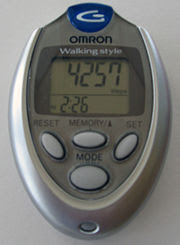
A pedometer (also known as Tomish-meter or step counter) is a device, which counts each step a person takes by detecting the motion of their hips. Originally, it was used by people engaged in sports and physical fitness but now it becomes popular as an everyday exercise measurer and motivator.
The modern pedometer is usually portable and electronic or electromechanical; a typical one is shown below:
It was observed in the study that people who walked 20 to 40 minutes a day lost a small but steady amount of weight. According to the researchers, the increase in physical activity can have health benefits independent of weight loss. In fact, increasing physical activity is expected to lower the risk of cardiovascular problems and blood pressure, and will help dieters keep lean muscle tissue when they are dieting.
A total of 9 studies involving 307 men and women were reviewed in the study. The participants took part in the studies of pedometer use, which ranged from 4 weeks to a year.
Participants in all the studies except one lost some weight (about 0.05 kilo a week on average). The weight loss was found to be 'remarkably consistent' across all of the studies, and this added up to 2.25 kilos over a year.
It is believed that changing eating habits could help even more. People could add between 2,000 steps per day to more than 4,000 steps per day. For an average person, 2,000 steps equals to about 0.6 km.